
Universal audio VOLT 2 MAX

Studio-quality sound on your desk
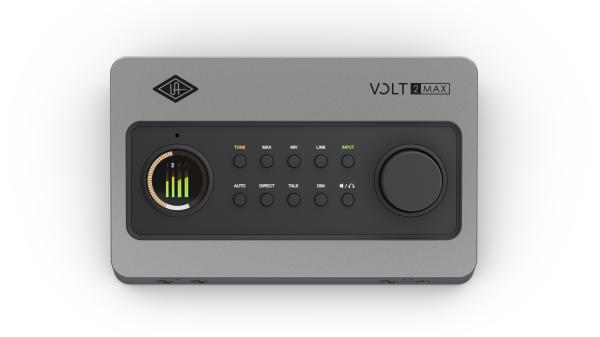
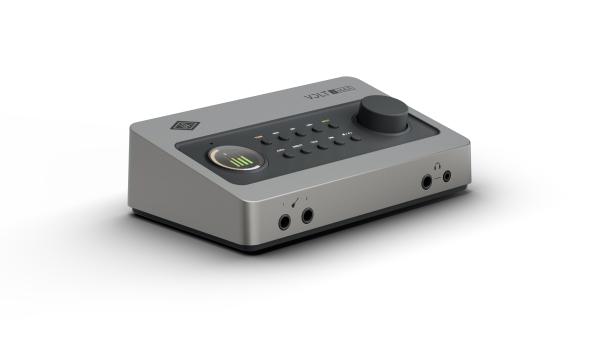
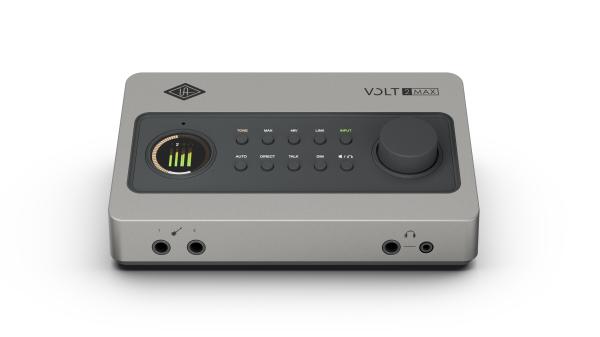
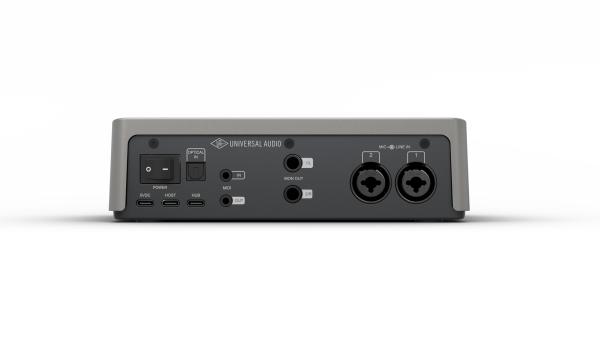
The Volt 2 Max is a next-generation USB audio interface designed to offer a wealth of processing capabilities and connectivity options in a compact desktop format.
Developed by the team behind the Apollo interfaces, it lets you add character to your recordings right from the start thanks to its Tone Shaping preamps and Max dynamics processor.
Its Smart Display, Auto-Gain, and clipping protection features simplify setup, while ADAT, MIDI, and talkback make it easy to integrate into more comprehensive studio setups.
Three Tone Shaping modes to shape the character of your recordings
The Volt 2 Max’s two microphone preamps feature 60 dB of gain and three harmonic coloring modes:
Warmth: to add a warm character inspired by tube circuits
Focus: for a precise and present sound
Shine: to capture the brilliant character of a British Class A preamp
These modes let you quickly adjust the sonic personality of vocals and instruments right during recording.
Built-in Max Dynamics Processor
The Volt 2 Max features a real-time Max compressor.
It offers six musical presets specifically designed for different sources such as vocals, guitars, and basses.
Among the available settings are presets such as “Rap Vocals” and “Jangly Acoustic.”
The processing is inspired by classic studio compressors such as the 1176 and the LA-2A.
By combining the three Tone Shaping modes with the six Max presets, the Volt 2 Max offers 18 possible sound combinations that are directly accessible during recording.
32-bit / 192 kHz Audio Conversion
The Volt 2 Max is equipped with professional converters offering a resolution of up to 32-bit / 192 kHz.
This allows it to accurately capture the nuances of vocals, instruments, and other recorded sources.
Two inputs for vocals, instruments, and line sources
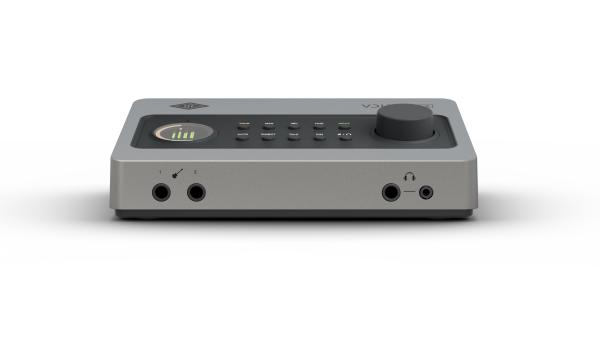
The Volt 2 Max features two mic/line inputs as well as two Hi-Z instrument inputs.
In particular, it allows you to record simultaneously:
two vocals
two instruments
one vocal and one instrument
a stereo source
Each microphone input features independently switchable +48 V phantom power, enabling the use of condenser microphones.
ADAT and S/PDIF digital expansion
The optical input allows you to expand the number of available inputs via ADAT or use an S/PDIF digital connection.
In ADAT mode, it supports:
8 channels at 44.1 or 48 kHz
4 channels in S/MUX mode at 96 kHz
2 channels in S/MUX mode at 192 kHz
In S/PDIF mode, it supports 2 channels at all supported sample rates.
Built-in MIDI
The Volt 2 Max features a MIDI input and output via 3.5 mm TRS Type A mini-jacks.
This allows you to connect MIDI controllers, keyboards, synthesizers, or drum machines to your setup.
Smart Display color screen
The Smart Display lets you quickly view important information about your inputs, levels, and settings.
It also displays the amount of gain reduction applied by the Max compressor, making it easier to monitor dynamic processing during recording.
Auto-Gain and Overdrive Protection
The Auto-Gain feature automatically adjusts input levels in just a few seconds.
Clip protection, meanwhile, helps manage unexpected peaks to minimize the risk of digital clipping.
These features let you focus more on your performance and less on level adjustments.
Built-in Talkback Microphone
A talkback microphone is built directly into the Volt 2 Max.
It allows you to easily communicate with musicians or others in another room or behind a studio window, without requiring a separate dedicated microphone.
Two Headphone Outputs
The Volt 2 Max features two stereo headphone outputs that share the same monitor mix.
This configuration facilitates collaborative recording sessions, such as those involving a musician and a sound engineer or two performers.
Built-in USB hub
A USB hub port allows you to connect an additional device and provides up to 5 V DC / 0.5 A of power.
In particular, it can be used to connect or power certain compatible USB MIDI controllers.
Integration with UAD Console and LUNA
The Volt 2 Max features integration with UAD Console and LUNA, including session recall and low-latency headphone monitoring.
It also remains compatible with the leading digital audio workstations on the market.
Loopback for Podcasting and Streaming
The Loopback feature allows you to mix sources connected to the interface with audio from the computer.
It is particularly well-suited for:
podcasts
livestreams
content creation
video calls
recordings combining a microphone, instruments, and system audio
Combined with the talkback microphone, this feature enhances the interface’s versatility for production and broadcasting applications.
Key Features
10-input / 4-output USB audio interface
Desktop format
Professional 32-bit / 192 kHz audio conversion
2 microphone preamps with 60 dB of gain
Three Tone Shaping modes: Warmth, Focus, and Shine
Built-in Max compressor
6 compression presets
Processing inspired by the 1176 and LA-2A compressors
18 Tone + Max combinations
2 mic/line inputs
2 Hi-Z instrument inputs
ADAT/S/PDIF optical input
Up to 8 additional channels via ADAT
MIDI input and output
Built-in talkback microphone
2 headphone outputs
Built-in USB hub
Smart Display color screen
Gain reduction display
Auto-Gain function
Clip protection
Independent +48 V phantom power per channel
Loopback function
Integration with UAD Console
Integration with LUNA
Low-latency headphone monitor output
USB-powered
Compatible with Mac, Windows, iPad, and iPhone
Rugged construction
UAD software suite and third-party software included
Included Software
UAD Volt Studio Bundle
LUNA
Topline Vocal Tune
UA 610 Tube Preamp & EQ Collection
Century Tube Channel Strip
Teletronix LA-2A Tube Compressor
UA 1176 Classic FET Compressor
Pure Plate Reverb
Galaxy Tape Echo
Oxide Tape Recorder
Vibe Analog Machines
PolyMAX Synth
Anthem Analog Synth
UAD Lion ’68 Super Lead Amp
UAD Showtime ’64 Tube Amp
Additional Software
Celemony Melodyne Essential
Plugin Alliance Ampeg SVT-VR Classic Bass Bundle
Ampeg SVT-VR Classic
bx_Tuner
bx_Masterdesk_Classic
UJAM Virtual Drummer DEEP
UJAM Virtual Bassist DANDY
Splice INSTRUMENT
UVI Prisma – Producer Lab
FL Studio Producer Edition – 3 months free
Exclusive Puremix tutorial content
The UAD Volt Studio bundles and third-party software are subject to change without notice.
Simultaneous I/O: 10 inputs / 4 outputs
Mic preamps: 2
Preamp gain: 60 dB
Built-in processing: Tone Shaping, harmonic saturation, and Max compressor
Speaker outputs: 1 stereo pair
Headphone outputs: 2 stereo outputs, shared mix
USB: 1 USB 2.0 host port
USB hub: 1 port, max power output 5 V DC / 0.5 A
External power input: 5 V DC / 1 A minimum
USB connection: USB-C
Digital / optical connection: ADAT or S/PDIF input
MIDI: Input and output
Talkback: Built-in microphone
ADAT / S/PDIF
ADAT
8 channels: 44.1 / 48 kHz
4 channels S/MUX: 96 kHz
2 channels S/MUX: 192 kHz
S/PDIF
2 channels at all supported sample rates
MIDI
MIDI input: Yes
MIDI output: Yes
Connectors: 3.5 mm TRS mini-jacks
Type: MIDI Type A
A/D and D/A conversion
Digital audio resolution: 32-bit
Supported sample rates:
44.1 kHz
48 kHz
88.2 kHz
96 kHz
176.4 kHz
192 kHz
Power
USB-powered: Yes
Power consumption at 5 V DC: 4.1 W typical
Maximum power consumption: 5.7 W
On/off switch: Yes, on the rear panel
Analog I/O
Instrument inputs 1-2
Frequency response: 20 Hz – 20 kHz, ±0.02 dB
A-weighted dynamic range: 116 dB
THD + Noise, 1 kHz at -1 dBFS: -108 dB / 0.0004%
Maximum input level: 13 dBu
Input impedance: 1 MΩ
Available gain: 60 dB, digitally controlled
Connectors: 1/4" (6.35 mm) TS unbalanced jack
Microphone inputs 1-2
Frequency response: 20 Hz – 20 kHz, ±0.08 dB
A-weighted dynamic range: 119 dB
THD + Noise, 1 kHz at -1 dBFS: -110 dB / 0.0003%
Maximum input level: 14 dBu
Input impedance: 2 kΩ
Available gain: 60 dB, digitally controlled
Phantom power: +48 V, switchable per channel
Connectors: XLR/jack combo, pin 2 hot
Line inputs 1-2
Frequency response: 20 Hz – 20 kHz, ±0.05 dB
A-weighted dynamic range: 119 dB
THD + Noise, 1 kHz at -1 dBFS: -108 dB / 0.0004%
Maximum input level: 22 dBu
Input impedance: 10 kΩ
Available gain: 60 dB, digitally controlled
Connectors: 1/4" (6.35 mm) TRS balanced or TS unbalanced jack
Speaker outputs
Frequency response: 20 Hz – 20 kHz, ±0.05 dB
A-weighted dynamic range: 126 dB
THD + Noise, 1 kHz at -1 dBFS: -112 dB / 0.0003%
Maximum output level: 20.2 dBu
Output impedance: 200 Ω
Connectors: Balanced 6.35 mm (1/4") TRS, DC-coupled
Headphone outputs
Number: 2
Frequency response: 20 Hz – 20 kHz, ±0.08 dB
A-weighted dynamic range: 116 dB
THD + noise, 1 kHz at -1 dBFS into 300 Ω: -103 dB / 0.0007%
Maximum power into 32 Ω: 45 mW
Maximum power into 300 Ω: 24 mW
Connectors: Unbalanced stereo 6.35 mm (1/4") and 3.5 mm (1/8") TRS, DC-coupled
Headphone mix: Shared between both outputs
System requirements
macOS and Windows
Available USB 2.0 port or higher
USB cable included
Intel, AMD, or Apple Silicon processor
Windows 10 64-bit or later
macOS 12 Monterey or later
Internet connection required for software download
iPad and iPhone
iPadOS / iOS 16 or later
Apple Lightning to USB adapter required for devices with a Lightning port
No Lightning adapter required for iPhones and iPads with a USB-C port
DAW compatibility
Compatible with major Digital Audio Workstations, including:
Ableton Live
FL Studio
GarageBand
Logic Pro
Pro Tools
LUNA
Euroguitar Referenz : 124697


